ARQ secrecy over correlated fading channels
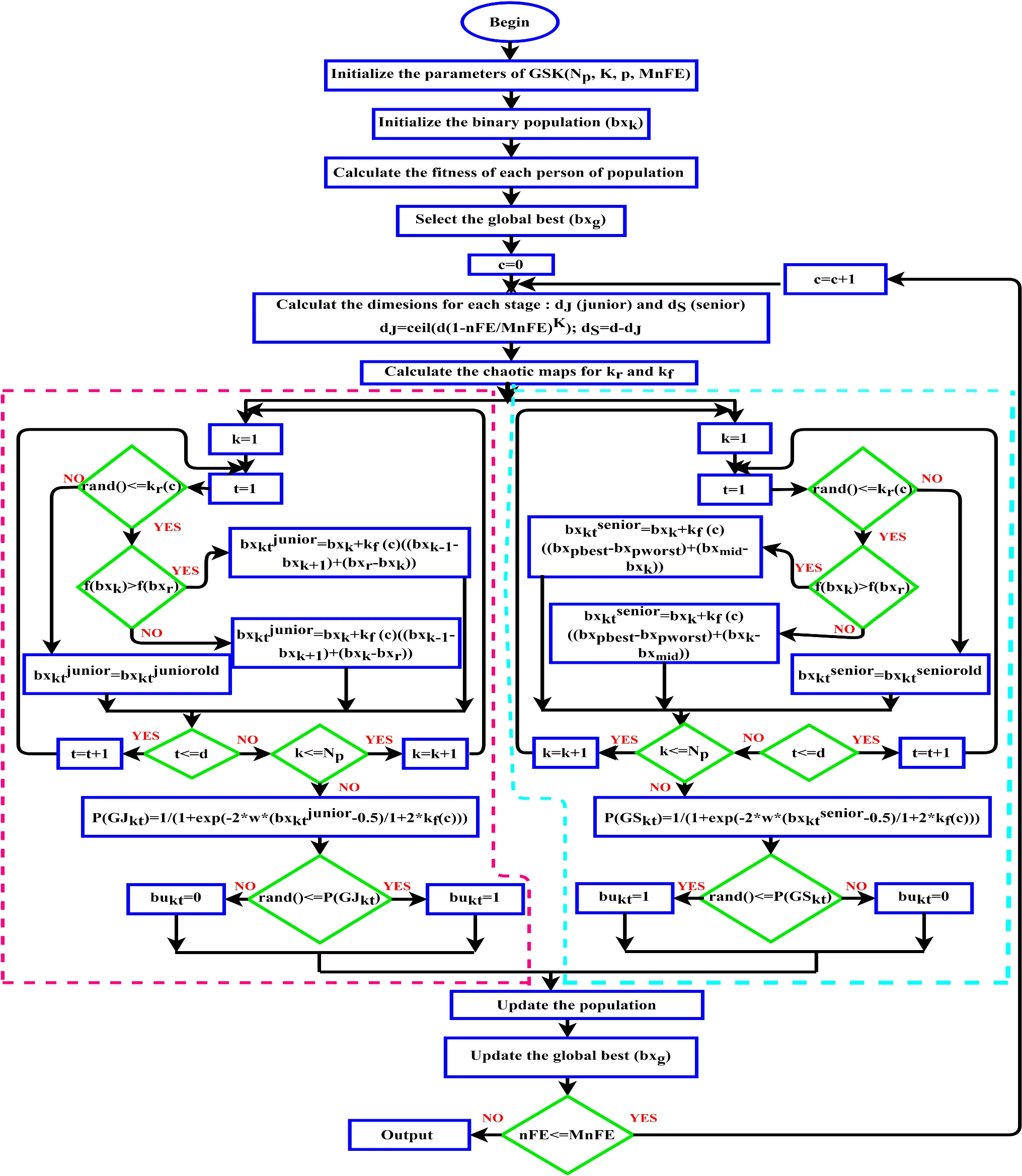
In this paper, we develop novel Automatic Repeat reQuest (ARQ) key sharing protocols for correlated fading channels. In particular, a novel role of "dumb antennas" in overcoming the negative impact of spatial correlation, on the achievable secrecy rates , is unveiled. We further develop an adaptive rate allocation policy which achieves higher secrecy rates by exploiting the channel temporal correlation. The performance gains offered by the proposed schemes are demonstrated by a comprehensive set of numerical results.
ARQ secrecy: From theory to practice
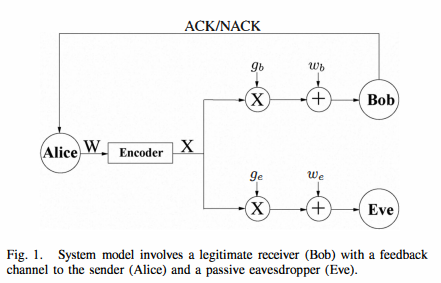
Inspired by our earlier work on Automatic Repeat reQuest (ARQ) secrecy, we propose a simple, yet efficient, security overlay protocol to existing 802.11 networks. Our work targets networks secured by theWired Equivalent Privacy (WEP) protocol because of its widespread use and vulnerability to a multitude of security threats. By exploiting the existing ARQ protocol in the 802.11 standard, our proposed opportunistic secrecy scheme is shown to defend against all known passive WEP attacks. Moreover, our implementation on the madwifi-ng driver is used to establish the achievability of a vanishing
Asymmetrical clipping optical filter bank multi-carrier modulation scheme
Authentication over noisy channels
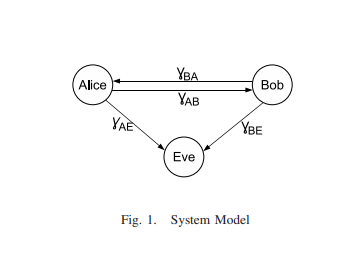
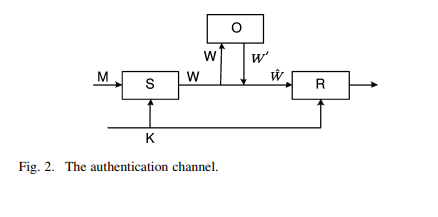
An authentication counterpart of Wyner's study of the wiretap channel is developed in this work. More specifically, message authentication over noisy channels is studied while impersonation and substitution attacks are investigated for both single- and multiple-message scenarios. For each scenario, information-theoretic lower and upper bounds on the opponent's success, or cheating, probability are derived. Remarkably, in both scenarios, the lower and upper bounds are shown to match, and hence, the fundamental limits on message authentication over noisy channels are fully characterized. The
Towards Extended Bit Tracking for Scalable and Robust RFID Tag Identification Systems
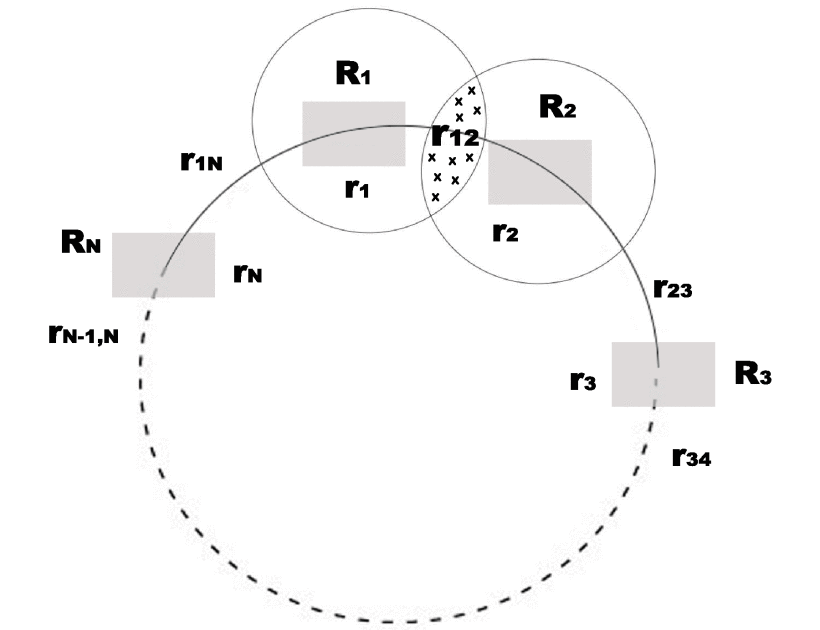
The surge in demand for Internet of Things (IoT) systems and applications has motivated a paradigm shift in the development of viable radio frequency identification technology (RFID)-based solutions for ubiquitous real-Time monitoring and tracking. Bit tracking-based anti-collision algorithms have attracted considerable attention, recently, due to its positive impact on decreasing the identification time. We aim to extend bit tracking to work effectively over erroneous channels and scalable multi RFID readers systems. Towards this objective, we extend the bit tracking technique along two

Interference-based optimal power-efficient access scheme for cognitive radio networks
In this paper, we propose a new optimization-based access strategy of multi-packet reception (MPR) channel for multiple secondary users (SUs) accessing the primary user (PU) spectrum. We devise an analytical model that realizes the multi-packet access strategy of the SUs. All the network receiving nodes have MPR capability. We aim at maximizing the throughput of the individual SUs subject to the PU's queue stability. Moreover, we are interested in providing an energy-efficient cognitive scheme. Therefore, we include energy constraints on the PU and SU average transmitted energy to the
Indoor localization and movement prediction algorithms with light-fidelity
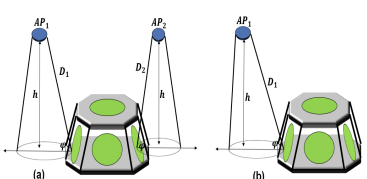
Indoor localization has recently attended an increase in interest due to the potential for a wide range of services. In this paper, indoor high-precision positioning and motion prediction algorithms are proposed by using light fidelity (LI-FI) system with angular diversity receiver (ADR). The positioning algorithm uses to estimate the location of an object in the room. Furthermore, the prediction algorithm applies to predict the motion of that object. The simulation results show that the average root mean squares error of the positioning algorithm is about 0.6 cm, and the standard deviation
Towards optimal resource allocation in caching at relay networks
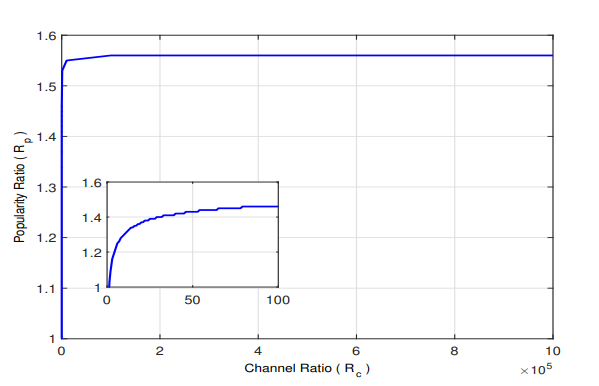
We investigate the performance of caching in relay networks where an intermediate relay station (RS) caches content for future demand by end users. With uncertain user demand over multiple data items and dynamically changing wireless links, we characterize the optimal transmission time for serving data items, cached data portion allocation of relay station and optimal service portion, which represents a part from the cached portion, to minimize the total average transmission energy. We argue that under several settings fully caching the higher popular items is the optimal caching policy which
Towards Mobility-Aware Proactive Caching for Vehicular Ad hoc Networks
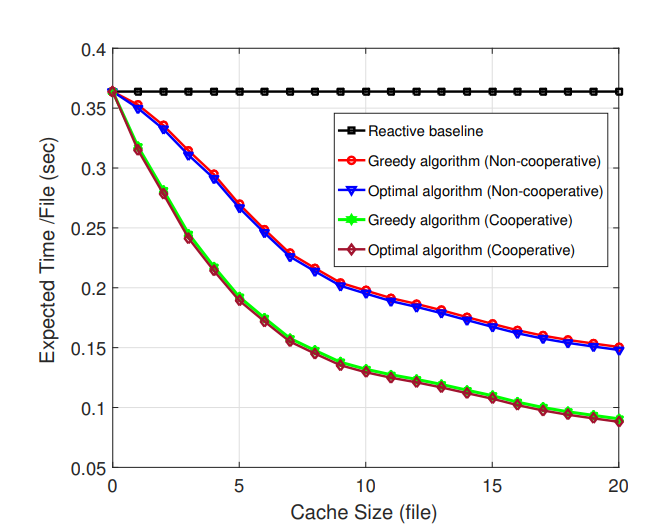
Harnessing information about the user mobility pattern and daily demand can enhance the network capability to improve the quality of experience (QoE) at Vehicular Ad- Hoc Networks (VANETs). Proactive caching, as one of the key features offered by 5G networks, has lately received much interest. However, more research is still needed to convey large-sized multimedia content including video, audio and pictures to the high speed moving vehicles. In this paper, we study the gains achieved by proactive caching in Roadside Units (RSUs) where we take into consideration the effect of the vehicle