

Optimum Selection of Communication Tower Structures Based on Wind Loads & lifecycle cost analysis
Communication towers are vital assets in our daily lives as they transfer signals between cell phones facilitating communication and commerce among people and businesses all around the world. Wind loads are crucial in the communication towers design since they are tall and slender. With climate change bringing more storms and higher wind speeds, it is more crucial to research the finest tower structure that withstands such conditions with the least life cycle cost. Therefore, in this paper, a comparative case study is performed between 45 m height lattice tower and monopole tower in Egypt. Two

Comparative Analysis of Wind-loaded Telecom Tower Structures with Recommendations
Telecommunication towers are essential infrastructure in today's fast-paced world. Lattice self-supporting towers, monopole towers, and guyed towers are the three types of structures that can be used for telecommunications towers. When analyzing telecom tower loads, wind loads are the most important ones to address. As a result, it is necessary to choose an appropriate structure that can withstand the wind and the surrounding environment. The main aim of this paper is to propose a guideline for selecting the optimum tower structure based on the surrounding environment. In order to create this
Light-Weight Food/Non-Food Classifier for Real-Time Applications
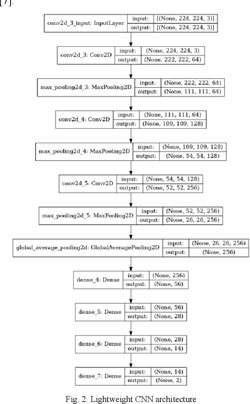
Today, automatic food/non-food classification became extremely important for many real-time applications, specifically since the pandemic of the COVID-19 virus. Such that the 'no food policy' now became applied more than ever to help decrease the spread of the COVID-19 virus. Consequently, many studies used deep neural networks for the food/non-food classification task, yet these deep neural networks were computationally expensive. As a result, in this paper, a lightweight Convolution Neural Network (CNN) is proposed and put into use for classifying foods and non-foods. Compared to prior
Joint Content Valuations and Proactive Caching for Content Distribution Networks
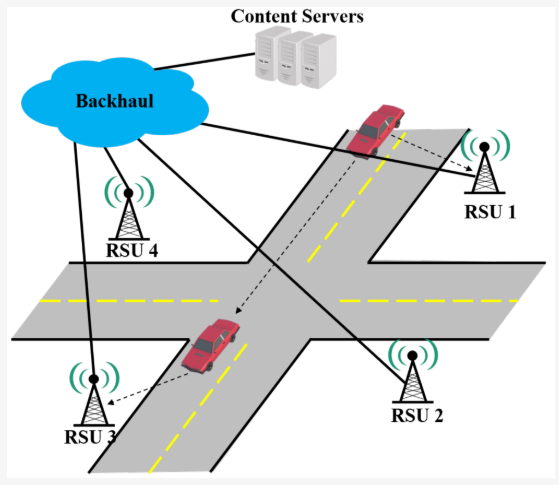
Due to the advances in machine learning techniques, recommender systems nowadays are capable of learning and influencing the users' decisions. Hence, recommendations became an important facility to reduce the cost (or increase the profit) of the operators of the demand networks. In this paper we formulate and study the problem of dynamically optimizing the demand shaping, through content recommendation, and proactive caching. The formulated problem suffers from the curse of dimensionality, so we devise an approximate algorithm optimizing only over a short look-ahead window. The approximate
A Probabilistic City Model Generation for Application in Internet of Vehicles Technology
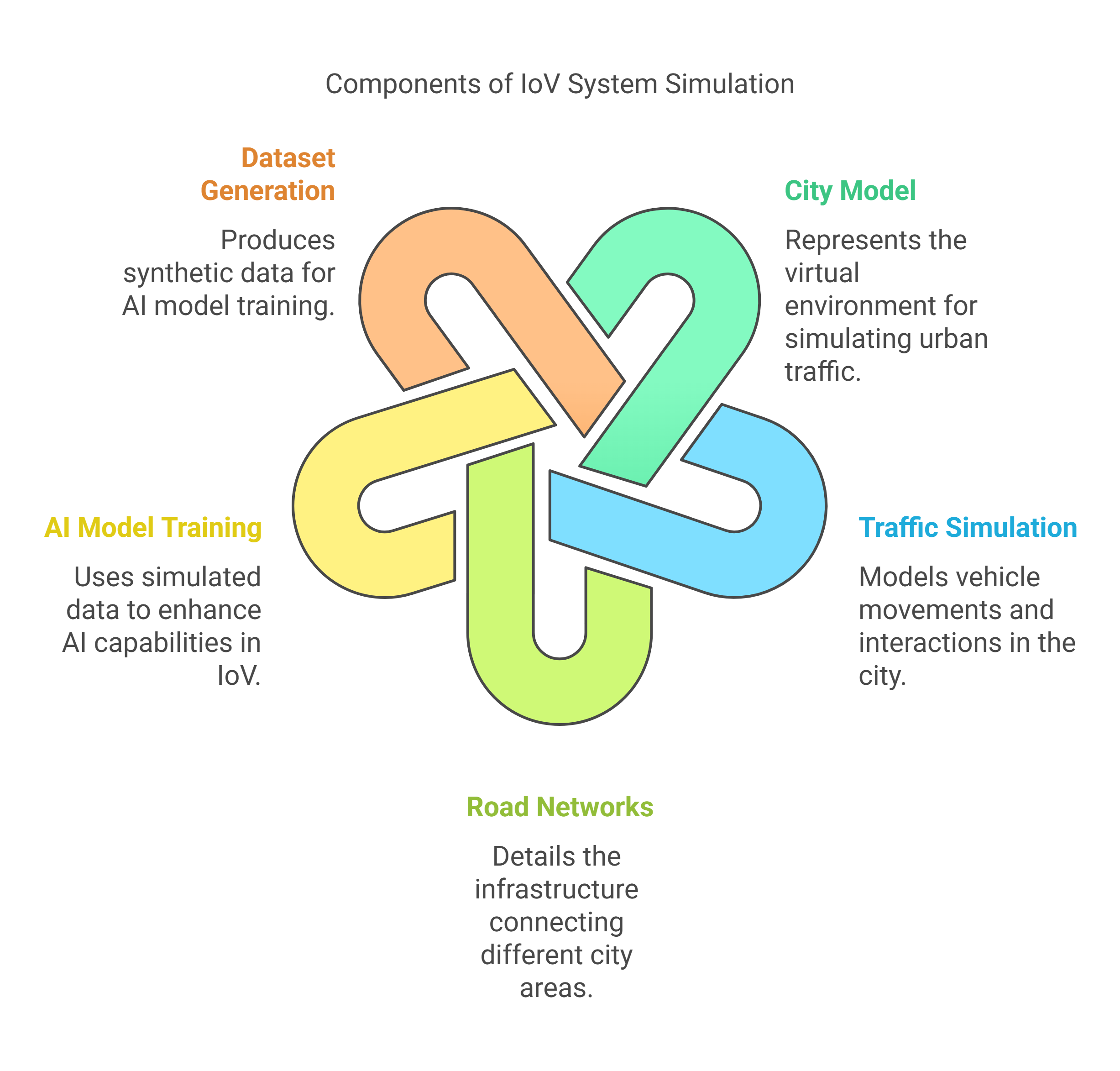
As the main pillar of the Smart City, Smart Highway manifests the centralized connectivity concept between the self-driving vehicles. Internet of Vehicle or IoV is the solution for improved connectivity between driverless vehicles. One of the major challenges in IoV research is the lack of datasets available. That is why the Internet of vehicles is one of the hot topics in research nowadays. IoV field is still a new topic in research, which leaves a huge shortage in the datasets available to train any Artificial Intelligent (AI) model for IoV systems. IoV systems have many research points such
Smart cloud platform for data management in the age of the internet of vehicles
Smart cars, with the emergence of the Internet of Vehicles (IoV), are expected to generate huge volumes of data at rates that typical data management systems will not be able to handle. Such data can be extremely useful to both analytics and machine learning applications. This paper discusses and demonstrates the process of architecting and building a scalable data management system for the IoV in a smart city environment, using Apache Spark, Apache Kafka and Apache Cassandra, which results in a scalable, resilient and fault-Tolerant data management system that facilitates performing big data

Chaos-Based RNG using Semiconductor Lasers with Parameters Variation Tolerance
Random numbers play an essential role in guaranteeing secrecy in most cryptographic systems. A chaotic optical signal is exploited to achieve high-speed random numbers. It could be generated by using one or more semiconductor lasers with external optical feedback. However, this system faces two major issues, high peak to average power ratio (PAPR) and parameter variations. These issues highly affected the randomness of the generated bitstreams. In this paper, we use a non-linear compression technique to compand the generated signal before it is quantized to avoid the effects of the PAPR. Also
Reliability and Security Analysis of an Entanglement-Based QKD Protocol in a Dynamic Ground-to-UAV FSO Communications System
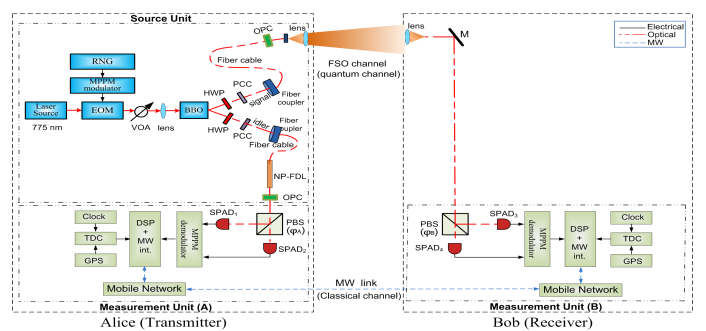
Quantum cryptography is a promising technology that achieves unconditional security, which is essential to a wide range of sensitive applications. In contrast to optical fiber, the free-space optical (FSO) link is efficiently used as a quantum channel without affecting the polarization of transmitted photons. However, the FSO link has several impairments, such as atmospheric turbulence and pointing errors, which affect the performance of the quantum channel. This paper proposes a quantum key distribution (QKD) scheme that uses a time-bin entanglement protocol over the FSO channel that suffers
Optimal resource allocation for green and clustered video sensor networks
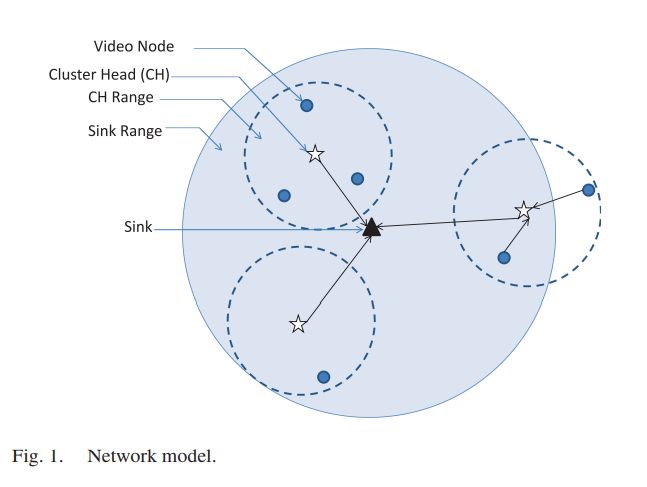
Wireless video sensor networks (WVSNs) are opening the door for many applications, such as industrial surveillance, environmental tracking, border security, and infrastructure health monitoring. In WVSN, energy conservation is very essential because: 1) sensors are usually battery-operated and 2) each sensor node needs to compress the video prior to transmission, which consumes more power than conventional wireless sensor networks. In this paper, we study the problem of minimizing the total power consumption in a cluster-based WVSN, leveraging cross-layer design to optimize the encoding power
Towards energy efficient relay placement and load balancing in future wireless networks
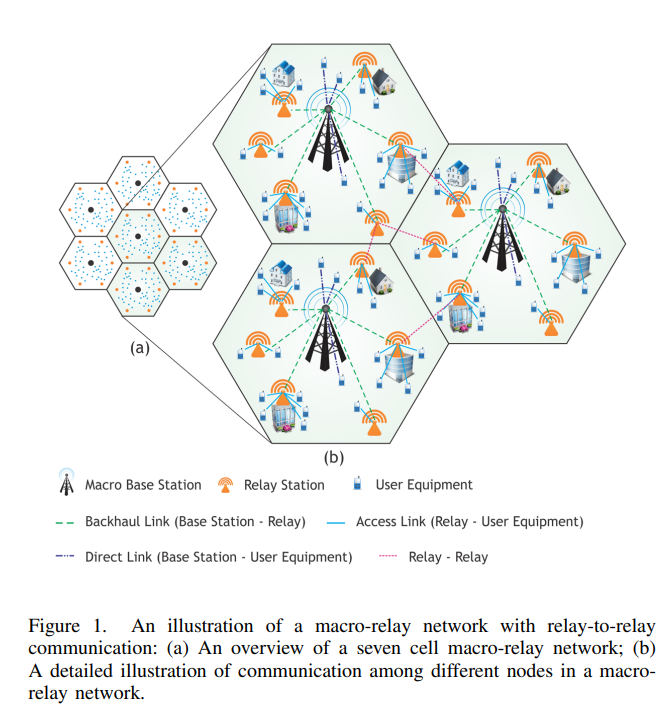
This paper presents an energy efficient relay deployment algorithm that determines the optimal location and number of relays for future wireless networks, including Long Term Evolution (LTE)-Advanced heterogeneous networks. We formulate an energy minimization problem for macro-relay heterogeneous networks as a Mixed Integer Linear Programming (MILP) problem. The proposed algorithm not only optimally connects users to either relays or eNodeBs (eNBs), but also allows eNBs to switch into inactive mode. This is possible by enabling relay-to-relay communication which forms the basis for relays to