

SSHC with One Capacitor for Piezoelectric Energy Harvesting
Piezoelectric vibration energy harvesters have attracted a lot of attention as a way to power self-sustaining electronic systems. Furthermore, as part of the growing Internet of Things (loT) paradigm, the ongoing push for downsizing and higher degrees of integration continues to constitute major drivers for autonomous sensor systems. Two of the most effective interface circuits for piezoelectric energy harvesters are synchronised switch harvesting (SSH) on inductor and synchronous electrical charge extraction; nevertheless, inductors are essential components in both interfaces. This study
Performance Analysis of M-ary DPSK with SIMO in Ground-to-HAP FSO System in the Presence of Beam Wander and Scintillation
Studying the performance of communication systems is essential to establish a reliable and stable link with an acceptable quality of service and minimum amount of resources. This paper evaluates the ground to HAP FSO link that uses the M-ary differential phase-shift keying (MDPSK) modulation technique in the presence of turbulence and beams wandering. The performance is analyzed by comparing the Average Symbol Error Rate (ASER) with an applicable threshold of 10-4. The results confirmed that, when limiting the transmitted power to 33 dBm, which is consistent with a practical perspective, the

Qualitative Concentration Analysis of Glucose in a solution using Spectroscopic Measurement
Glucose concentration change in solution was recorded by studying transmission and absorption coefficient at different laser wavelengths, showing decrease in transmittance and increase in absorption coefficient due to increased glucose concentration. © Optica Publishing Group 2021, © 2021 The Author(s)

Energy Aware Tikhonov-Regularized FPA Technique for Task Scheduling in Wearable Biomedical Devices
Harvesting the energy from environmental sources is a promising solution for perpetual and continuous operation of biomedical wearable devices. Although the energy harvesting technology ensures the availability of energy source, yet power management is crucial to ensure prolonged and stable operation under a stringent power budget. Thus, power-aware task scheduling can play a key role in minimizing energy consumption to improve system durability while maintaining device functionality. This chapter proposes a novel biosensor task scheduling of energy harvesting-based biomedical wearable devices

Energy Optimization and Cost Reduction in Water Distribution Networks
Since the majority of energy consumed by water supply systems is used in transporting and distributing water, in addition to the energy required to pump the water from its sources, energy consumption is significantly associated with the water demand. Several studies have been carried out to optimize pump operations to achieve appropriate pressure and reduce the energy associated with controlling water levels in storage facilities. In this paper, we develop an optimization and decision support technique for a Water Distribution Network (WDN) that considers energy efficiency by limiting the

Design, Simulation & Optimization on Electrical and Optical Parameters of Alq3 QW-OLED
Although the light-emitting diode (LED) was discovered in the 1900s, it is now widely used in lighting, screens, and a variety of other indoor and outdoor applications. (Organic Light Emitting Diode) OLED is one of the advancing branches of LED technology. In the structure of Alq3 OLEDs, highlight-efficiency optical materials such as TPD (hole transport layer) and Alq3 (electron transport layer) have been used. Organic light emitting layers are between two electrical contacts. The anode was made of indium tin oxide (ITO), and the cathode was made of aluminiumlithium (Al/Li). This article
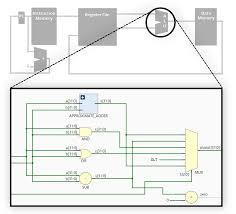
Single-Cycle MIPS Processor based on Configurable Approximate Adder
Enhancing computer architecture performance is a significant concern for architecture designers and users. This paper presents a novel approach to computer architecture design by using an approximate adder with configurable accuracy in a single-cycle MIPS processor as a study case. Using approximate adders decreased the delay on the expense of the design area. Using approximate computing with the MIPS processor, the timing performance has been improved by 253.4% compared to the lookahead adder. It has been implemented and tested using System-Verilog. © 2022 IEEE.
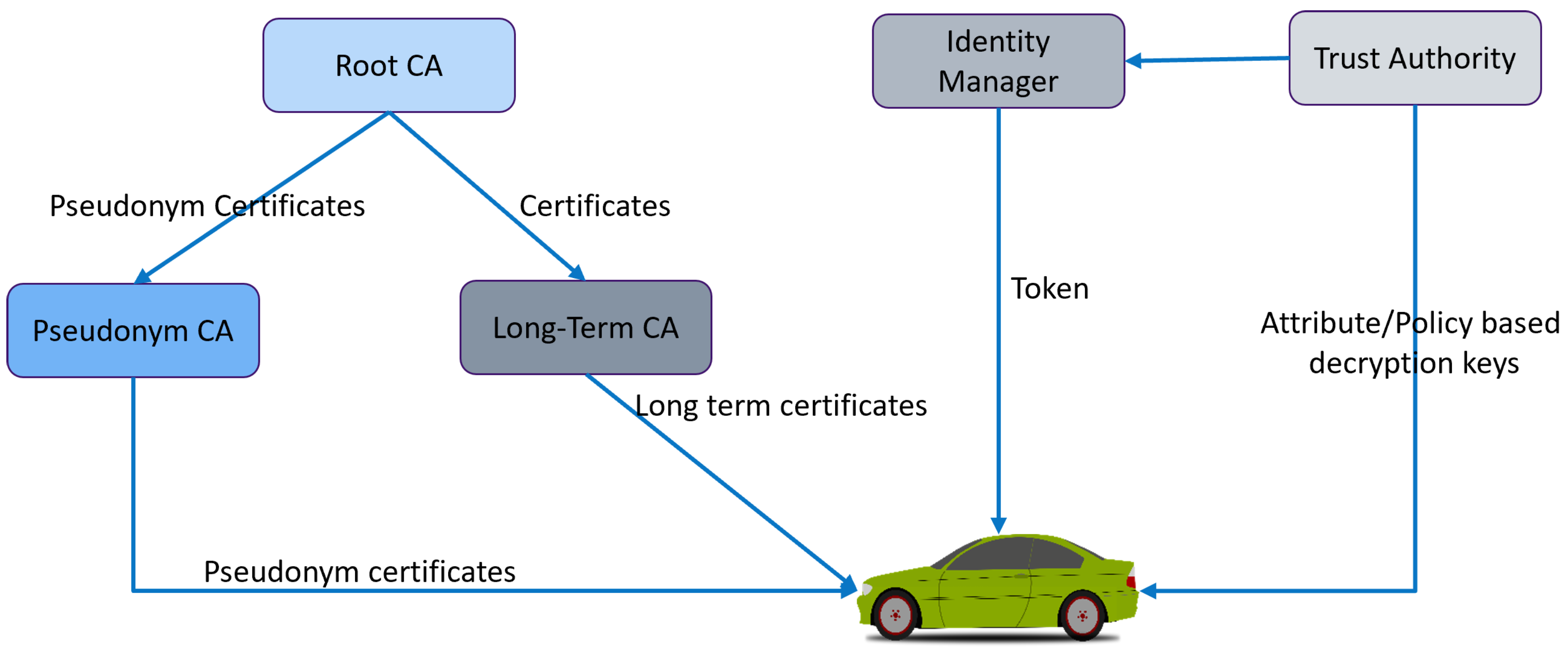
Developing Smart Control Platoon Algorithm for Secure VANET Environment
A vehicular ad hoc network (VANET) is a part of smart transportation. As a result of the vehicles being able to communicate with one another and share sensitive information, it is necessary to have an environment that can be trusted. Vehicles are clustered into platoons to ensure the secure transfer of information between them and select the platoon head of each platoon to control the vehicles. This paper proposes a smart control platoon system employing local and global trust schemes among vehicles in order to establish a secure environment. The platoon head calculates the local trust in each
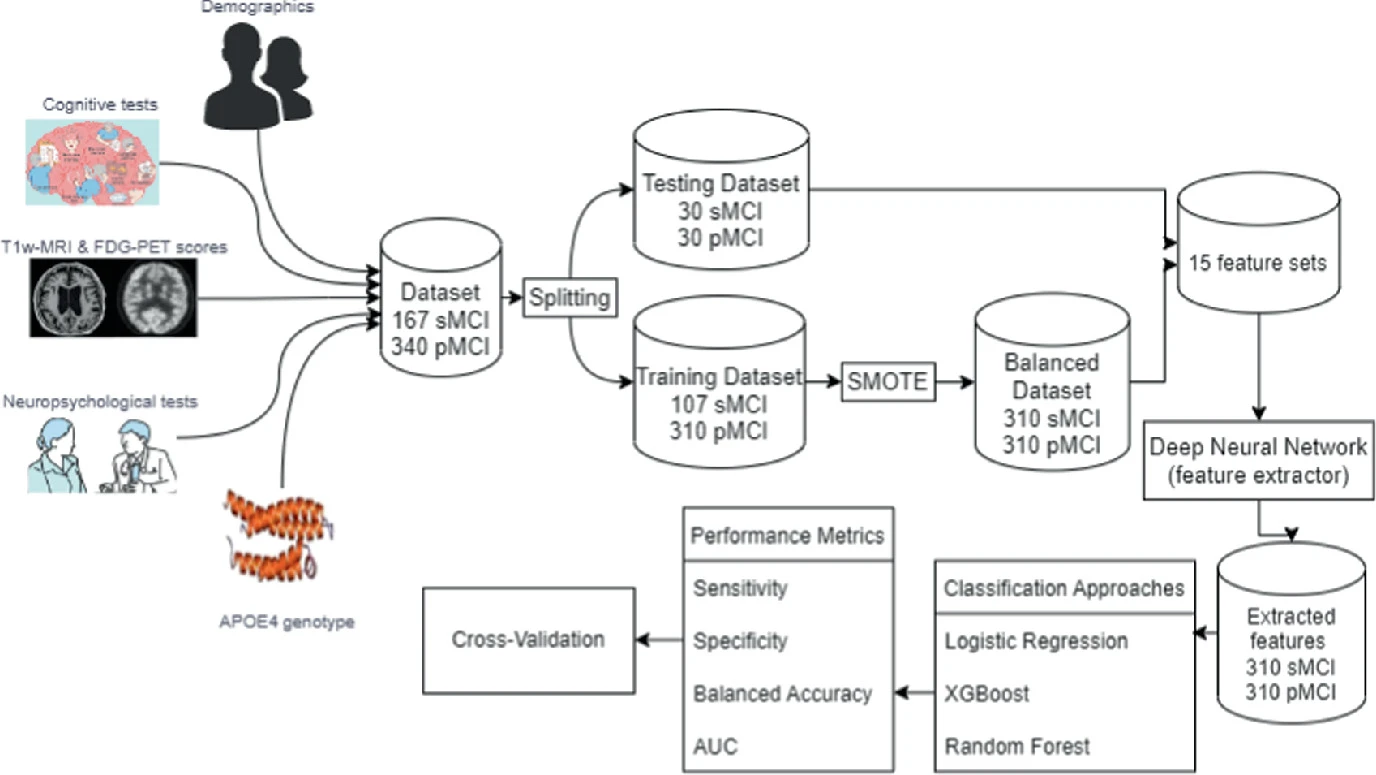
A Novel Diagnostic Model for Early Detection of Alzheimer’s Disease Based on Clinical and Neuroimaging Features
Alzheimer’s Disease (AD) is a dangerous disease that is known for its characteristics of eroding memory and destroying the brain. The classification of Alzheimer's disease is an important topic that has recently been addressed by many studies using Machine Learning (ML) and Deep Learning (DL) methods. Most research papers tackling early diagnosis of AD use these methods as a feature extractor for neuroimaging data. In our research paper, the proposed algorithm is to optimize the performance of the prediction of early diagnosis from the multimodal dataset by a multi-step framework that uses a
Deep Learning Approaches for Epileptic Seizure Prediction: A Review
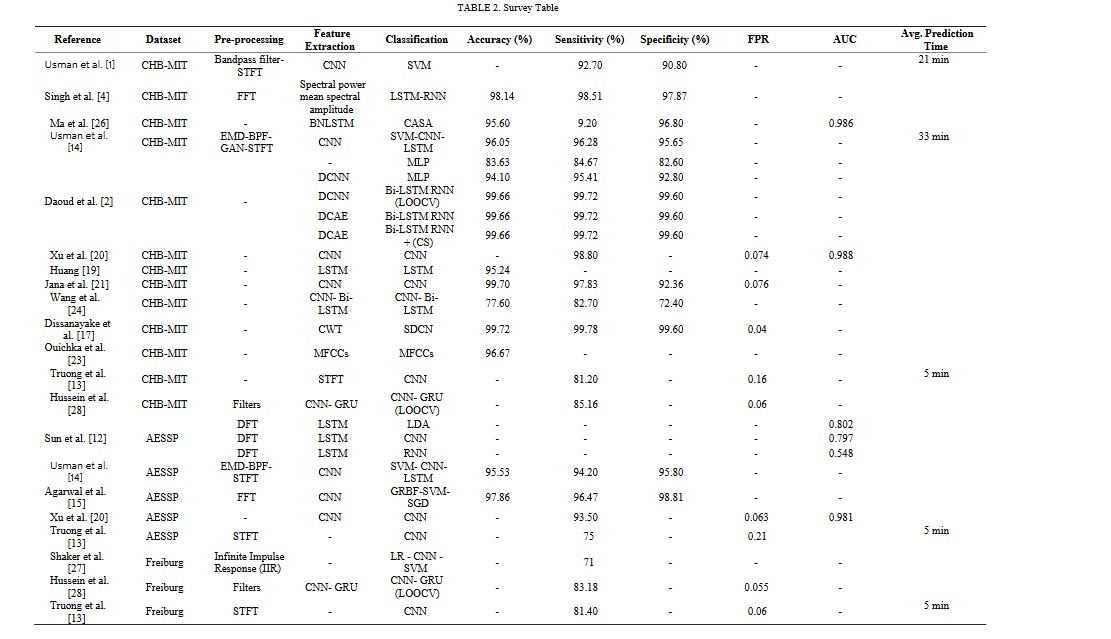
Epilepsy is a chronic nervous disorder, which disturbs the normal daily routine of an epileptic patient due to sudden seizure onset that may cause loss of consciousness. Seizures are periods of aberrant brain activity patterns. Early prediction of an epileptic seizure is critical for those who suffer from it as it will give them time to prepare for an incoming seizure and alert anyone in their close circle of contacts to aid them. This has been an active field of study, powered by the decreasing cost of non-invasive electroencephalogram (EEG) collecting equipment and the rapid evolution of