
Gaining-sharing knowledge based algorithm for solving optimization problems: a novel nature-inspired algorithm
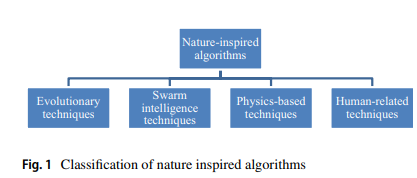
This paper proposes a novel nature-inspired algorithm called Gaining Sharing Knowledge based Algorithm (GSK) for solving optimization problems over continuous space. The GSK algorithm mimics the process of gaining and sharing knowledge during the human life span. It is based on two vital stages, junior gaining and sharing phase and senior gaining and sharing phase. The present work mathematically models these two phases to achieve the process of optimization. In order to verify and analyze the performance of GSK, numerical experiments on a set of 30 test problems from the CEC2017 benchmark for
Gaining-Sharing Knowledge Based Algorithm with Adaptive Parameters for Engineering Optimization
As optimization algorithms have a great power to solve nonlinear, complex, and hard optimization problems, nature-inspired algorithms have been applied extensively in distinct fields in order to solve real life optimization cases. In this paper, modifications for the recently proposed Gaining-Sharing-Knowledge based algorithm (GSK) are presented for enhancing its performance. Gaining-Sharing-Knowledge algorithm is considered as a perfect example of modern nature-inspired algorithm that considered the human life behavior as a source of inspiration in order to solve optimization problems. GSK
Deep stacked ensemble learning model for COVID-19 classification
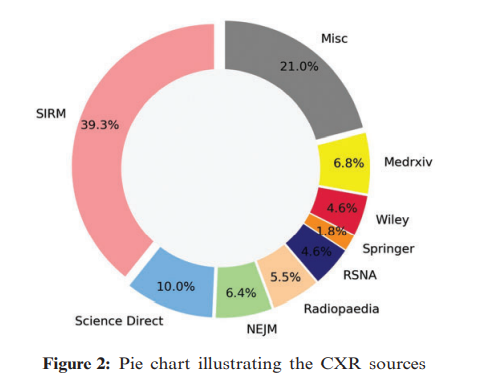
COVID-19 is a growing problem worldwide with a high mortality rate. As a result, the World Health Organization (WHO) declared it a pandemic. In order to limit the spread of the disease, a fast and accurate diagnosis is required. A reverse transcript polymerase chain reaction (RT-PCR) test is often used to detect the disease. However, since this test is time-consuming, a chest computed tomography (CT) or plain chest X-ray (CXR) is sometimes indicated. The value of automated diagnosis is that it saves time and money by minimizing human effort. Three significant contributions are made by our
A subspace method for the blind identification of multiple time-varying FIR channels
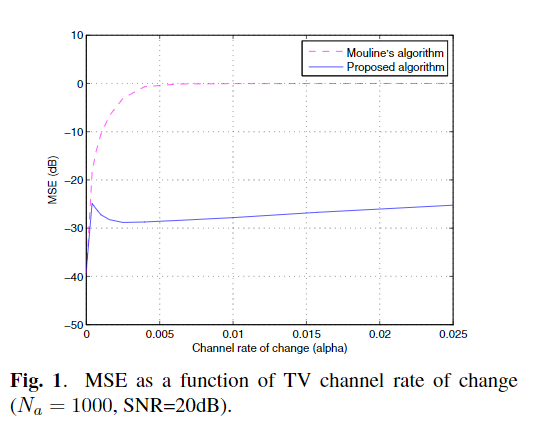
A new method is proposed for the blind subspace-based identification of the coefficients of time-varying (TV) single-input multiple-output (SIMO) FIR channels. The TV channel coefficients are represented via a finite basis expansion model, i.e. linear combination of known basis functions. In contrast to earlier related works, the basis functions need not be limited to complex exponentials, and therefore do not necessitate the a priori estimation of frequency parameters. This considerably simplifies the implementation of the proposed method and provides added flexibility in applications. The
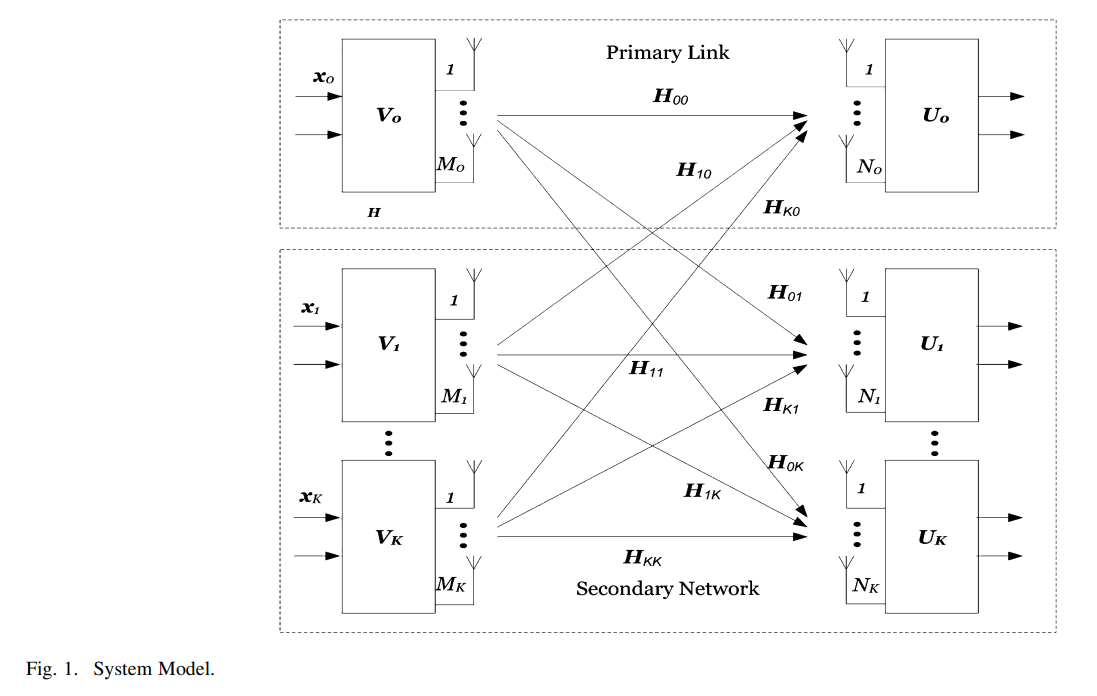
Constrained interference alignment and the spatial degrees of freedom of mimo cognitive networks
An interference alignment (IA) scheme is presented that allows multiple opportunistic transmitters (secondary users) to use the same frequency band of a pre-existing primary link without generating any interference. The primary and secondary transmit-receive pairs are equipped with multiple antennas. Under power constraints on the primary transmitter, the rate of the primary user is maximized by water-filling on the singular values of its channel matrix leaving some eigen modes unused, and hence, the secondary users can align their transmitted signals to produce a number of interference-free

Optimizing Cooperative Cognitive Radio Networks Performance with Primary QoS Provisioning
We consider the problem of optimizing the performance of a cooperative cognitive radio user subject to constraints on the quality-of-service (QoS) of the primary user (PU). In particular, we design the probabilistic admission control parameter of the PU packets in the secondary user (SU) relaying queue and the randomized service parameter at the SU under non-work-conserving (non-WC) and WC cooperation policies. In the non-WC policy, two constrained optimization problems are formulated; the first problem is maximizing the SU throughput while the second problem is minimizing the SU average delay
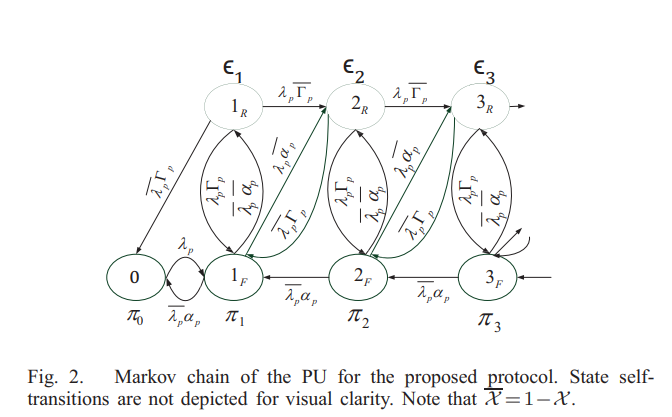
Maximum throughput of a secondary user cooperating with an energy-aware primary user
This paper proposes a cooperation protocol between a secondary user (SU) and a primary user (PU) which dedicates a free frequency subband for the SU if cooperation results in energy saving. Time is slotted and users are equipped with buffers. Under the proposed protocol, the PU releases portion of its bandwidth for secondary transmission. Moreover, it assigns a portion of the time slot duration for the SU to relay primary packets and achieve a higher successful packet reception probability at the primary receiver. We assume that the PU has three states: idle, forward, and retransmission states
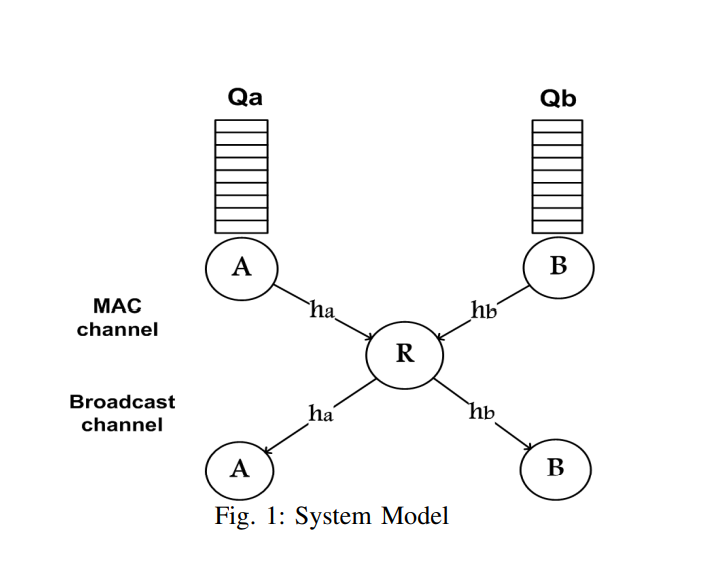
Maximum throughput opportunistic network coding in Two-Way Relay networks
In this paper, we study Two-Way Relaying (TWR) networks well-known for its throughput merits. In particular, we study the fundamental throughput delay trade-off in TWR networks using opportunistic network coding (ONC). We characterize the optimal ONC policy that maximizes the aggregate network throughput subject to an average packet delay constraint. Towards this objective, first, we consider a pair of nodes communicating through a common relay and develop a two dimensional Markov chain model capturing the buffers' length states at the two nodes. Second, we formulate an optimization problem
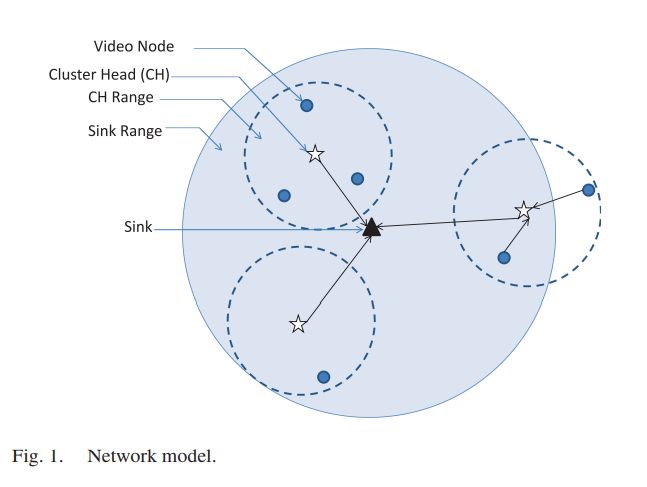
Optimal resource allocation for green and clustered video sensor networks
Wireless video sensor networks (WVSNs) are opening the door for many applications, such as industrial surveillance, environmental tracking, border security, and infrastructure health monitoring. In WVSN, energy conservation is very essential because: 1) sensors are usually battery-operated and 2) each sensor node needs to compress the video prior to transmission, which consumes more power than conventional wireless sensor networks. In this paper, we study the problem of minimizing the total power consumption in a cluster-based WVSN, leveraging cross-layer design to optimize the encoding power
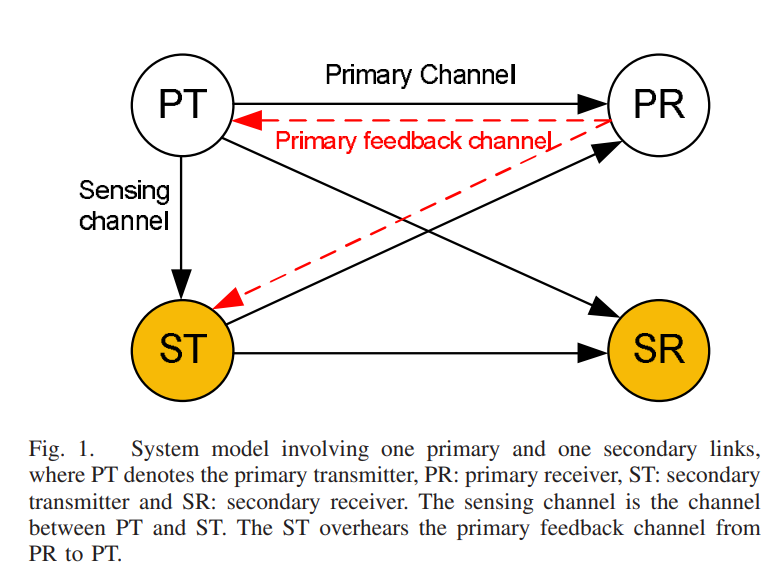
Leveraging primary feedback and spectrum sensing for cognitive access
We consider a time-slotted primary system where both the primary channel and primary activity are modeled as two independent two-state Markov chains. The primary transmitter can be idle or busy, whereas the channel can be in erasure or not. Moreover, the sensing channel between the primary transmitter and secondary transmitter is modeled as a two-state Markov chain to represent two levels of sensing reliability. At the beginning of each time slot, the secondary transmitter may remain idle, transmit directly, or probe the channel and access the channel only if it is sensed to be free. At the