
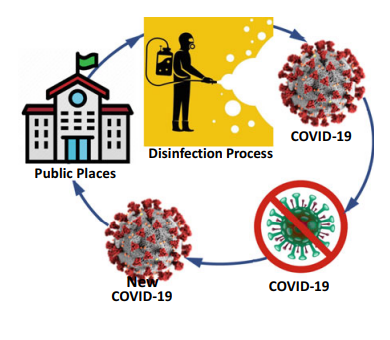
Optimum Scheduling of the Disinfection Process for COVID-19 in Public Places with a Case Study from Egypt, a Novel Discrete Binary Gaining-Sharing Knowledge-Based Metaheuristic Algorithm
The aim of this paper is to introduce an improved strategy for controlling COVID-19 and other pandemic episodes as an environmental disinfection culture for public places. The scheduling aims at achieving the best utilization of the available working day-time hours, which is calculated as the total consumed disinfection times minus the total loosed transportation times. The proposed problem in network optimization identifies a disinfection group who is likely to select a route to reach a subset of predetermined public places to be regularly disinfected with the most utilization of the
Optimum Location of Field Hospitals for COVID-19: A Nonlinear Binary Metaheuristic Algorithm
Determining the optimum location of facilities is critical in many fields, particularly in healthcare. This study proposes the application of a suitable location model for field hospitals during the novel coronavirus 2019 (COVID-19) pandemic. The used model is the most appropriate among the threemost common locationmodels utilized to solve healthcare problems (the set covering model, the maximal covering model, and the P-median model). The proposed nonlinear binary constrained model is a slight modification of the maximal covering model with a set of nonlinear constraints. The model is used to
Optimum distribution of protective materials for COVID−19 with a discrete binary gaining-sharing knowledge-based optimization algorithm
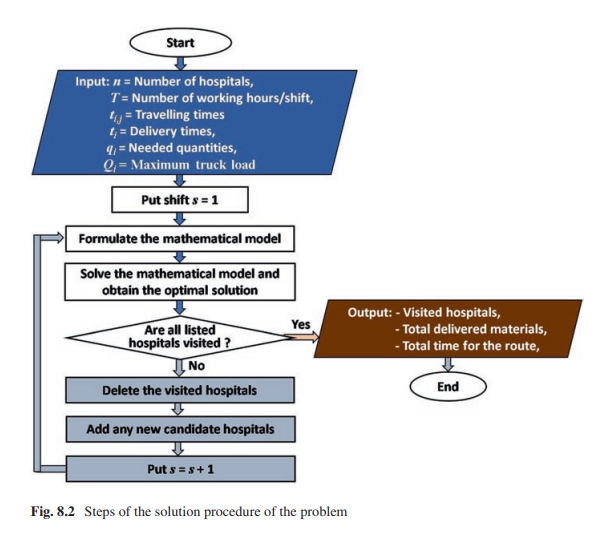
Many application problems are formulated as nonlinear binary programming models which are hard to be solved using exact algorithms especially in large dimensions. One of these practical applications is to optimally distribute protective materials for the newly emerged COVID-19. It is defined for a decision-maker who wants to choose a subset of candidate hospitals comprising the maximization of the distributed quantities of protective materials to a set of chosen hospitals within a specific time shift. A nonlinear binary mathematical programming model for the problem is introduced with a real