

Stability Analysis and Fault Detection of Telecommunication Towers Using Decision Tree Algorithm under Wind Speed Condition
This paper presents a decision tree (DT) modeling technique to estimate any increase in the load on telecommunication towers. A structural analysis was done for the lattice and mono-pole towers using TNX Tower software to determine the basic features of the towers, such as tilt angle, deflection, twist, and acceleration. The structure analysis generated a data set based on wind speeds. This data set was then used to train a machine-learning algorithm to estimate the loads on the structure. Any change in the applied loads greater than the loads considered in the design might be identified using

Indoor Air Quality Monitoring Systems for Sustainable Medical Rooms and Enhanced Life Quality
Indoor air pollution poses a substantial risk to human health and well-being, underscoring the crucial requirement for efficient monitoring systems. This paper introduces an advanced Air Pollution Monitoring System (APMS) tailored explicitly for indoor settings. The APMS integrates sensors and a user interface, ensuring the delivery of real-time and precise data concerning air quality parameters such as particulate matter (PM), volatile organic compounds (VOCs), carbon dioxide (CO2), as well as temperature and humidity. The proposed APMS has several advantages, including low maintenance

Correction to: Optimization of energy-constrained wireless powered communication networks with heterogeneous nodes (Wireless Networks, (2019), 10.1007/s11276-017-1587-x)
The original version of this article contained error in author affiliation. Also, the article note and acknowledgement sections are missing. © 2018, Springer Science+Business Media, LLC, part of Springer Nature.
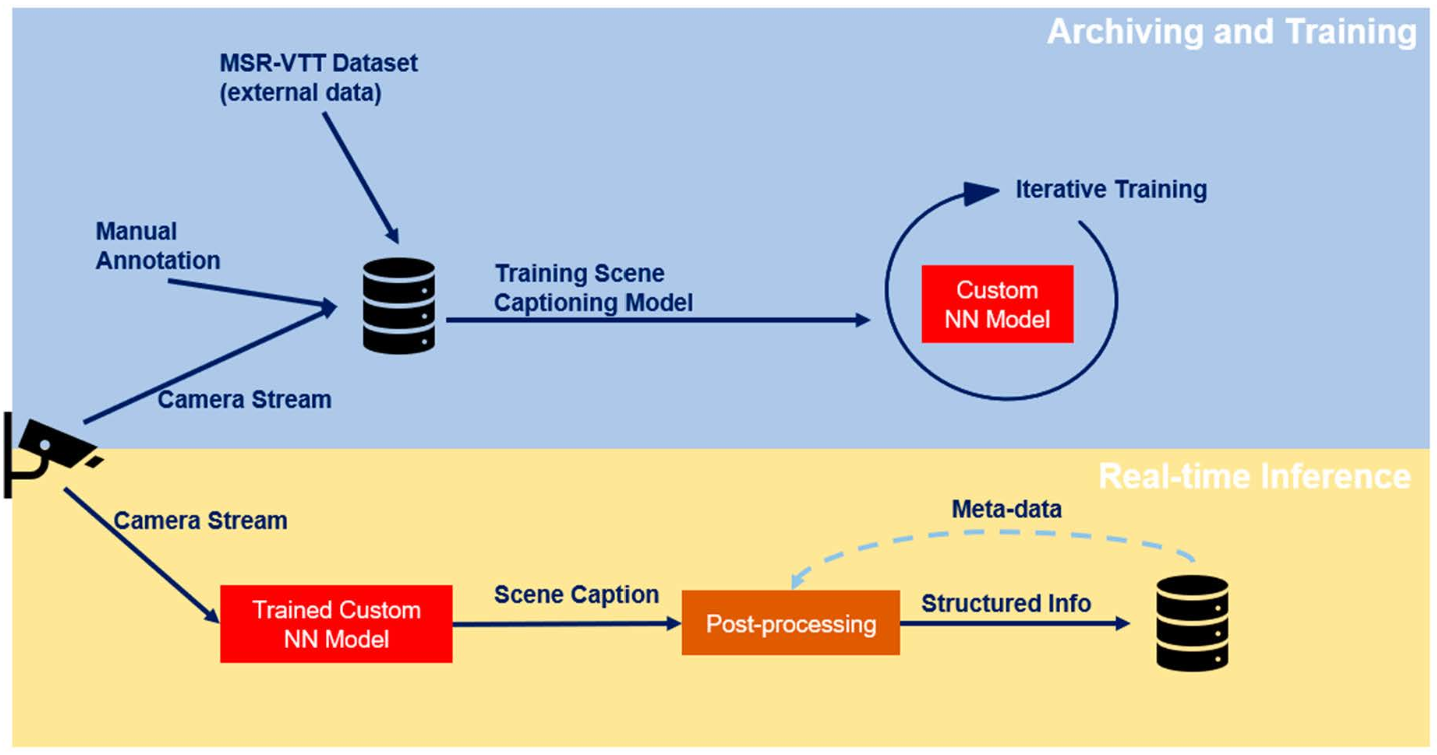
Deep Learning-Based Context-Aware Video Content Analysis on IoT Devices
Integrating machine learning with the Internet of Things (IoT) enables many useful applica-tions. For IoT applications that incorporate video content analysis (VCA), deep learning models are usually used due to their capacity to encode the high-dimensional spatial and temporal representations of videos. However, limited energy and computation resources present a major challenge. Video captioning is one type of VCA that describes a video with a sentence or a set of sentences. This work proposes an IoT-based deep learning-based framework for video captioning that can (1) Mine large open-domain

Light-Weight Food Image Classification For Egyptian Cuisine
Food is an integral aspect of daily life in all cultures. It highly affects people's diets, eating behaviors, and overall health. People with poor eating habits are usually overweight or obese, which leads to chronic diseases such as diabetes and cardiovascular disease. Today, the classification of food images has several uses in managing medical conditions and dieting. Deep convolutional neural network (DCNN) architectures provide the foundation for the most recent food recognition models. However, DCNNs are computationally expensive due to high computation time and memory requirements. In
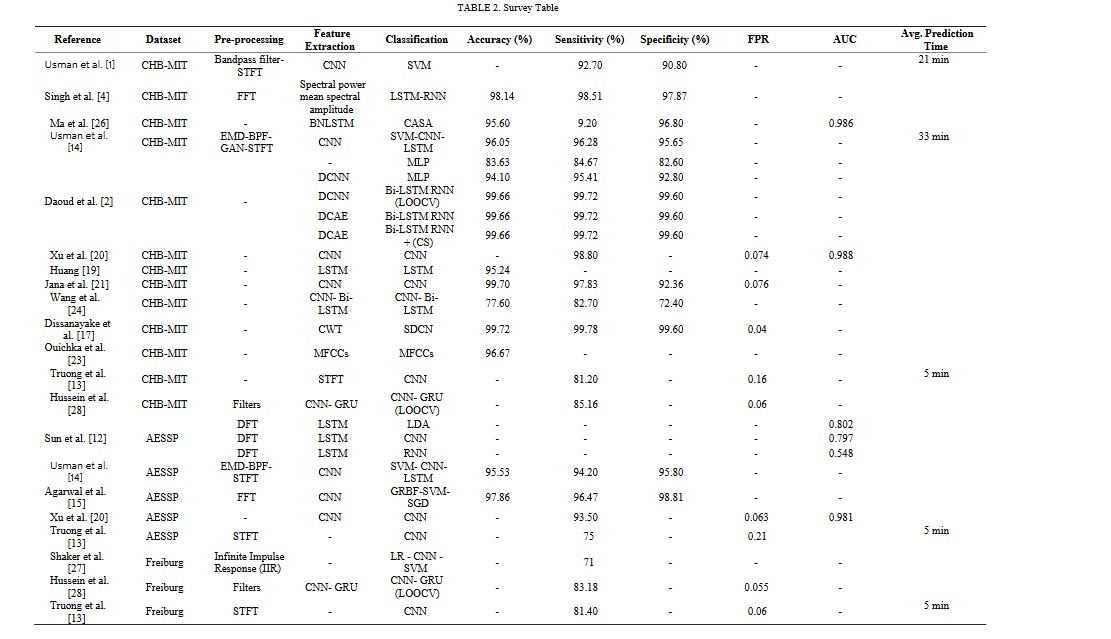
Deep Learning Approaches for Epileptic Seizure Prediction: A Review
Epilepsy is a chronic nervous disorder, which disturbs the normal daily routine of an epileptic patient due to sudden seizure onset that may cause loss of consciousness. Seizures are periods of aberrant brain activity patterns. Early prediction of an epileptic seizure is critical for those who suffer from it as it will give them time to prepare for an incoming seizure and alert anyone in their close circle of contacts to aid them. This has been an active field of study, powered by the decreasing cost of non-invasive electroencephalogram (EEG) collecting equipment and the rapid evolution of
Optimum Selection of Communication Tower Structures Based on Wind Loads & lifecycle cost analysis
Communication towers are vital assets in our daily lives as they transfer signals between cell phones facilitating communication and commerce among people and businesses all around the world. Wind loads are crucial in the communication towers design since they are tall and slender. With climate change bringing more storms and higher wind speeds, it is more crucial to research the finest tower structure that withstands such conditions with the least life cycle cost. Therefore, in this paper, a comparative case study is performed between 45 m height lattice tower and monopole tower in Egypt. Two

Comparative Analysis of Wind-loaded Telecom Tower Structures with Recommendations
Telecommunication towers are essential infrastructure in today's fast-paced world. Lattice self-supporting towers, monopole towers, and guyed towers are the three types of structures that can be used for telecommunications towers. When analyzing telecom tower loads, wind loads are the most important ones to address. As a result, it is necessary to choose an appropriate structure that can withstand the wind and the surrounding environment. The main aim of this paper is to propose a guideline for selecting the optimum tower structure based on the surrounding environment. In order to create this
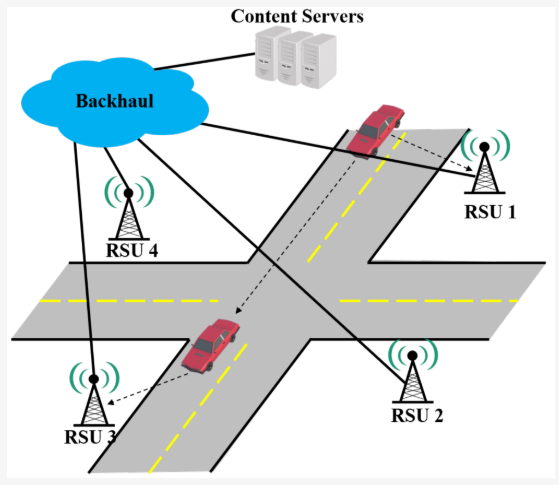
Joint Content Valuations and Proactive Caching for Content Distribution Networks
Due to the advances in machine learning techniques, recommender systems nowadays are capable of learning and influencing the users' decisions. Hence, recommendations became an important facility to reduce the cost (or increase the profit) of the operators of the demand networks. In this paper we formulate and study the problem of dynamically optimizing the demand shaping, through content recommendation, and proactive caching. The formulated problem suffers from the curse of dimensionality, so we devise an approximate algorithm optimizing only over a short look-ahead window. The approximate
Guava Trees Disease Monitoring Using the Integration of Machine Learning and Predictive Analytics
The increase in population, food demand, and the pollution levels of the environment are considered major problems of this era. For these reasons, the traditional ways of farming are no longer suitable for early and accurate detection of biotic stress. Recently, precision agriculture has been extensively used as a potential solution for the aforementioned problems using high resolution optical sensors and data analysis methods that are able to cope with the resolution, size and complexity of the signals from these sensors. In this paper, several methods of machine learning have been utilized