
Differential Evolution Mutations: Taxonomy, Comparison and Convergence Analysis
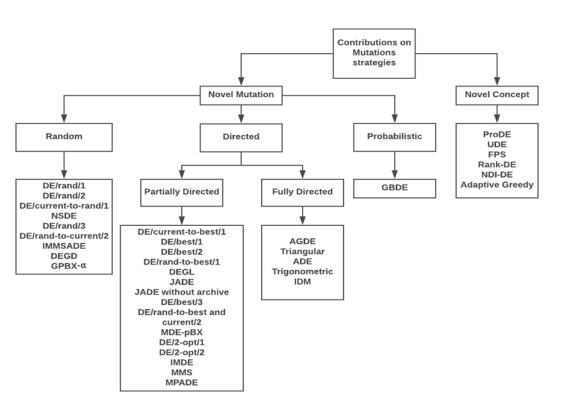
During last two decades, Differential Evolution (DE) proved to be one of the most popular and successful evolutionary algorithms for solving global optimization problems over continuous space. Proposing new mutation strategies to improve the optimization performance of (DE) is considered a significant research study. In DE, mutation operation plays a vital role in the performance of the algorithm. Therefore, in this paper, comprehensive analysis of the contributions on basic and novel mutation strategies that were proposed between 1995 and 2020 is presented. A new taxonomy based on the
A feedback-soft sensing-based access scheme for cognitive radio networks
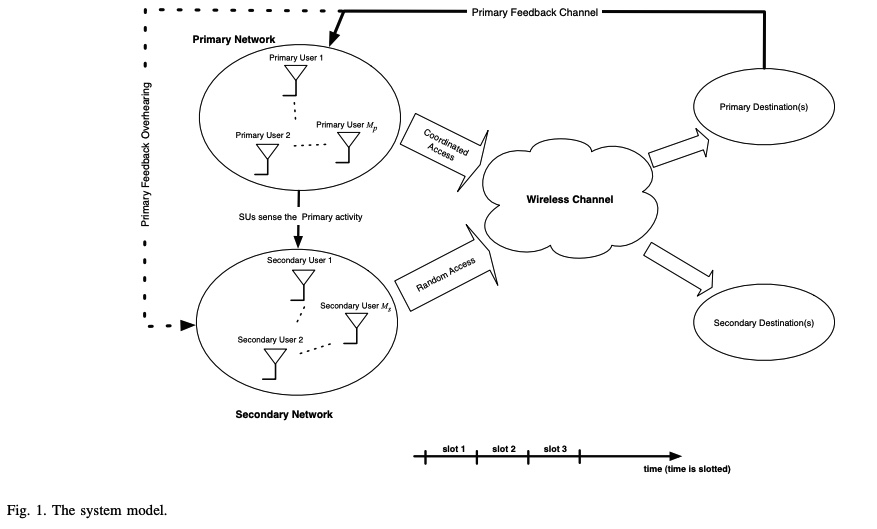
In this paper, we examine a cognitive spectrum access scheme in which secondary users exploit the primary feedback information. We consider an overlay secondary network employing a random access scheme in which secondary users access the channel by certain access probabilities that are functions of the spectrum sensing metric. In setting our problem, we assume that secondary users can eavesdrop on the primary link's feedback. We study the cognitive radio network from a queuing theory point of view. Access probabilities are determined by solving a secondary throughput maximization problem
A feedback-based access scheme for cognitive radio systems
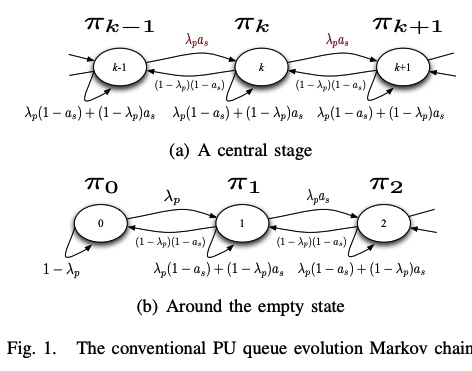
In this paper, we consider the design of access schemes for secondary users in cognitive radio systems based on the primary user feedback information. We consider a secondary user employing a random access scheme with an access probability that depends on the primary user feedback state. We show that the proposed scheme can enhance the system performance in terms of the secondary throughput and/or primary user delay while guaranteeing a certain quality of service (QoS) for the primary user; this is due to the fact that the proposed scheme avoids sure collisions between the primary and
A feedback-based access scheme for cognitive-relaying networks
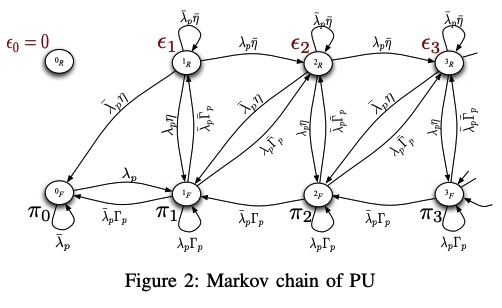
In this paper, we consider a cognitive relaying network in which the secondary user accesses the channel with a certain access probability that depends on the feedback information sent by the primary destination. In addition, the secondary user is granted relaying capabilities by which it can relay primary traffic that was unsuccessfully transmitted by the primary user. We show that this proposed scheme enhances the performance of the secondary user as well as the primary user, while the QoS requirements of the primary user is unviolated. The secondary user can avoid sure collisions with the
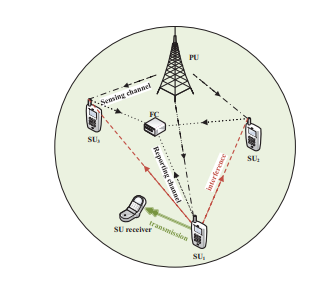
Full-duplex cooperative cognitive radio networks
In this paper, we study the impact of a full-duplex secondary node on a cognitive cooperative network with Multipacket Reception (MPR) capabilities at the receivers. Motivated by recent schemes that make full-duplex communication feasible, we study a model with one primary and one secondary transmitter-receiver pair, where the secondary transmitter is able to relay primary unsuccessful packets. Cooperation between primary and secondary users has been previously shown to be beneficial for the primary and the secondary users in terms of stable throughput. Our model assumes an imperfect full
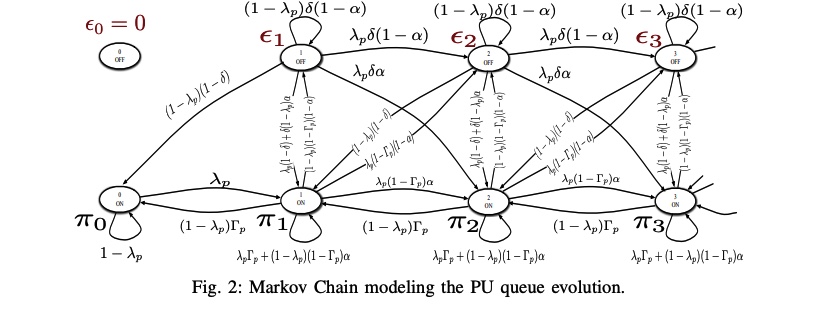
A feedback-soft sensing-based cognitive access scheme with feedback erasures
In this paper, we examine a cognitive spectrum access scheme in which a secondary user exploits the primary feedback information. We consider an overlay model in which the secondary user accesses the channel by certain access probabilities that are function of the spectrum sensing metric. In setting our problem, we assume that the secondary user can receive the primary link's feedback automatic repeat request (ARQ), but through an erasure channel. This means that the primary feedback may either be received correctly or is erased with a certain erasure probability. We study the cognitive radio
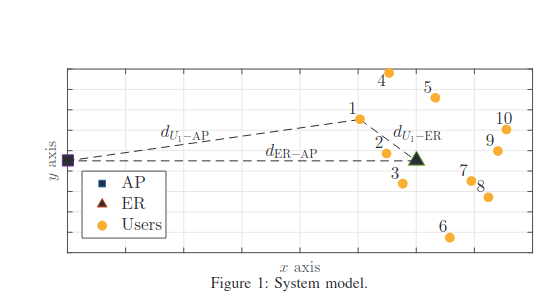
Non-Orthogonal Multiple Access schemes in Wireless Powered Communication Networks
We characterize time and power allocations to optimize the sum-throughput of a Wireless Powered Communication Network (WPCN) with Non-Orthogonal Multiple Access (NOMA). In our setup, an Energy Rich (ER) source broadcasts wireless energy to several devices, which use it to simultaneously transmit data to an Access Point (AP) on the uplink. Differently from most prior works, in this paper we consider a generic scenario, in which the ER and AP do not coincide, i.e., are two separate entities. We study two NOMA decoding schemes, namely Low Complexity Decoding (LCD) and Successive Interference