
Comparative Analysis of Wind-loaded Telecom Tower Structures with Recommendations
Telecommunication towers are essential infrastructure in today's fast-paced world. Lattice self-supporting towers, monopole towers, and guyed towers are the three types of structures that can be used for telecommunications towers. When analyzing telecom tower loads, wind loads are the most important ones to address. As a result, it is necessary to choose an appropriate structure that can withstand the wind and the surrounding environment. The main aim of this paper is to propose a guideline for selecting the optimum tower structure based on the surrounding environment. In order to create this
Light-Weight Food/Non-Food Classifier for Real-Time Applications
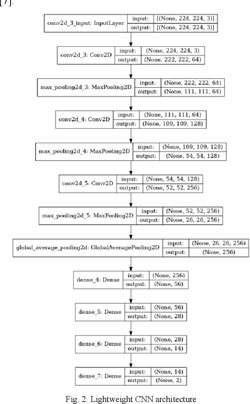
Today, automatic food/non-food classification became extremely important for many real-time applications, specifically since the pandemic of the COVID-19 virus. Such that the 'no food policy' now became applied more than ever to help decrease the spread of the COVID-19 virus. Consequently, many studies used deep neural networks for the food/non-food classification task, yet these deep neural networks were computationally expensive. As a result, in this paper, a lightweight Convolution Neural Network (CNN) is proposed and put into use for classifying foods and non-foods. Compared to prior
Joint Content Valuations and Proactive Caching for Content Distribution Networks
Due to the advances in machine learning techniques, recommender systems nowadays are capable of learning and influencing the users' decisions. Hence, recommendations became an important facility to reduce the cost (or increase the profit) of the operators of the demand networks. In this paper we formulate and study the problem of dynamically optimizing the demand shaping, through content recommendation, and proactive caching. The formulated problem suffers from the curse of dimensionality, so we devise an approximate algorithm optimizing only over a short look-ahead window. The approximate
A Probabilistic City Model Generation for Application in Internet of Vehicles Technology
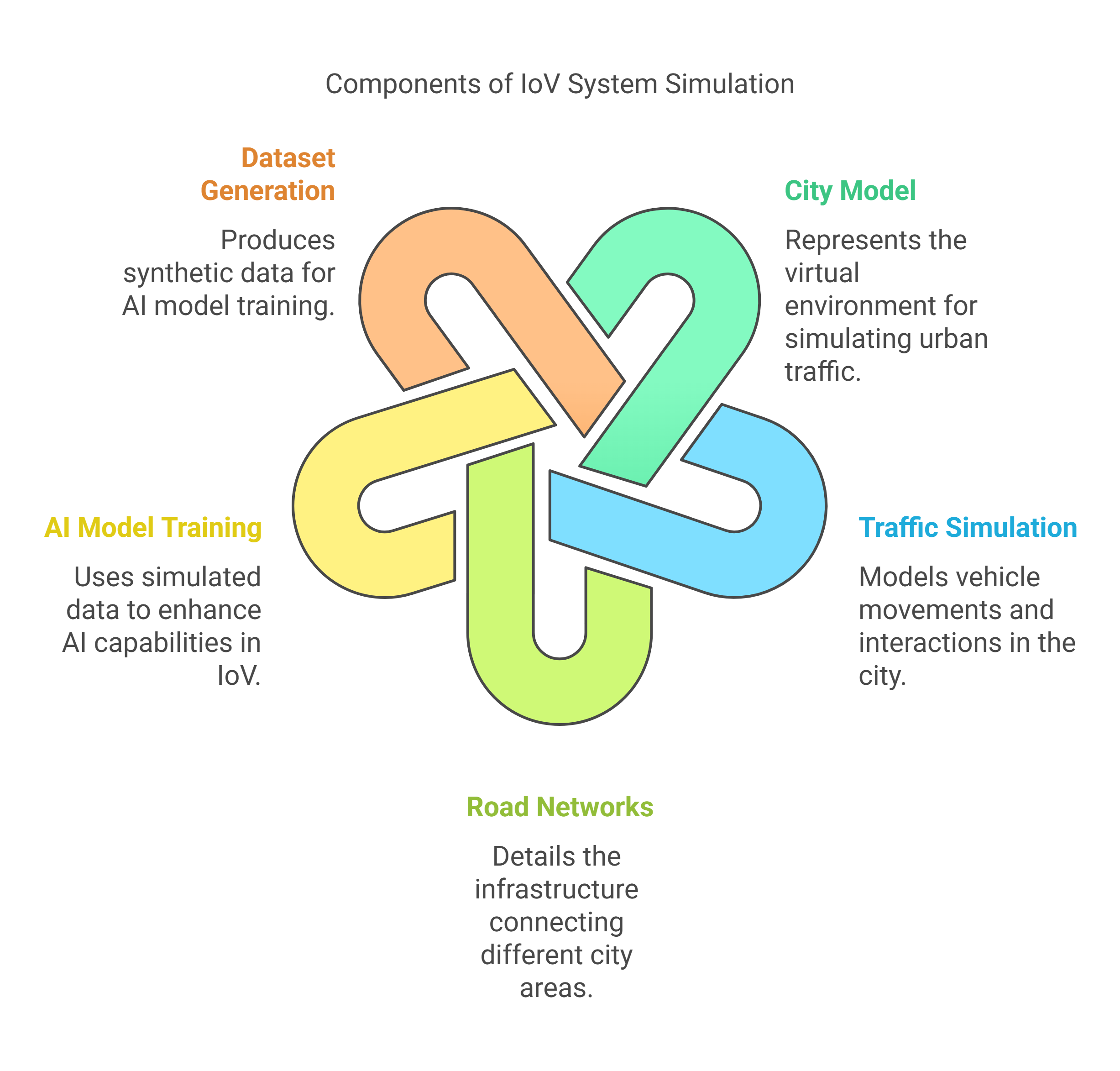
As the main pillar of the Smart City, Smart Highway manifests the centralized connectivity concept between the self-driving vehicles. Internet of Vehicle or IoV is the solution for improved connectivity between driverless vehicles. One of the major challenges in IoV research is the lack of datasets available. That is why the Internet of vehicles is one of the hot topics in research nowadays. IoV field is still a new topic in research, which leaves a huge shortage in the datasets available to train any Artificial Intelligent (AI) model for IoV systems. IoV systems have many research points such
Smart cloud platform for data management in the age of the internet of vehicles
Smart cars, with the emergence of the Internet of Vehicles (IoV), are expected to generate huge volumes of data at rates that typical data management systems will not be able to handle. Such data can be extremely useful to both analytics and machine learning applications. This paper discusses and demonstrates the process of architecting and building a scalable data management system for the IoV in a smart city environment, using Apache Spark, Apache Kafka and Apache Cassandra, which results in a scalable, resilient and fault-Tolerant data management system that facilitates performing big data
Overlapping multihop clustering for wireless sensor networks
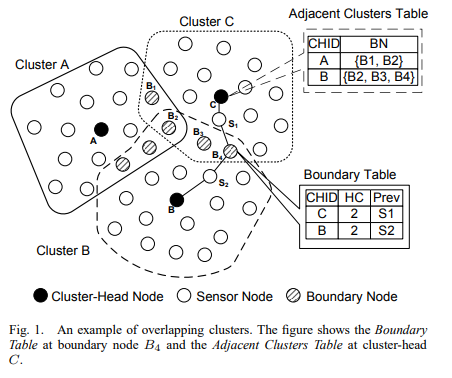
Clustering is a standard approach for achieving efficient and scalable performance in wireless sensor networks. Traditionally, clustering algorithms aim at generating a number of disjoint clusters that satisfy some criteria. In this paper, we formulate a novel clustering problem that aims at generating overlapping multihop clusters. Overlapping clusters are useful in many sensor network applications, including intercluster routing, node localization, and time synchronization protocols. We also propose a randomized, distributed multihop clustering algorithm (KOCA) for solving the overlapping
Neural Knapsack: A Neural Network Based Solver for the Knapsack Problem
Collision Probability Computation for Road Intersections Based on Vehicle to Infrastructure Communication
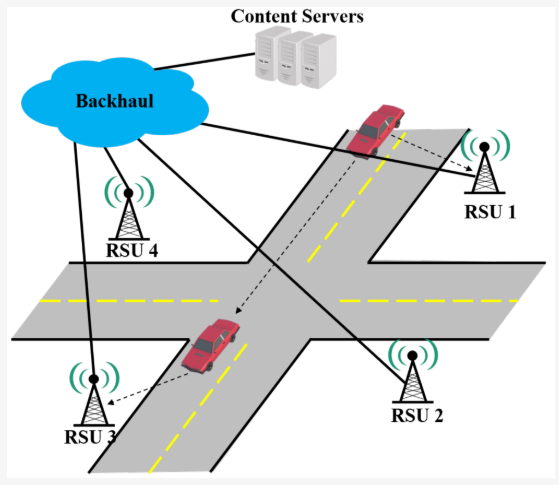
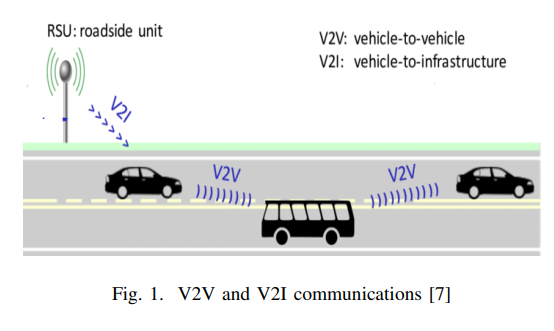
In recent years, many probability models proposed to calculate the collision probability for each vehicle and those models used in collision avoidance algorithms and intersection management algorithms. In this paper, we introduce a method to calculate the collision probability of vehicles at an urban intersection. The proposed model uses the current position, speed, acceleration, and turning direction then each vehicle shares its required information to the roadside unit (RSU) via the Vehicle to Infrastructures (V2I). RSU can predict each vehicle's path in intersections by using the received
A Review of Machine learning Use-Cases in Telecommunication Industry in the 5G Era
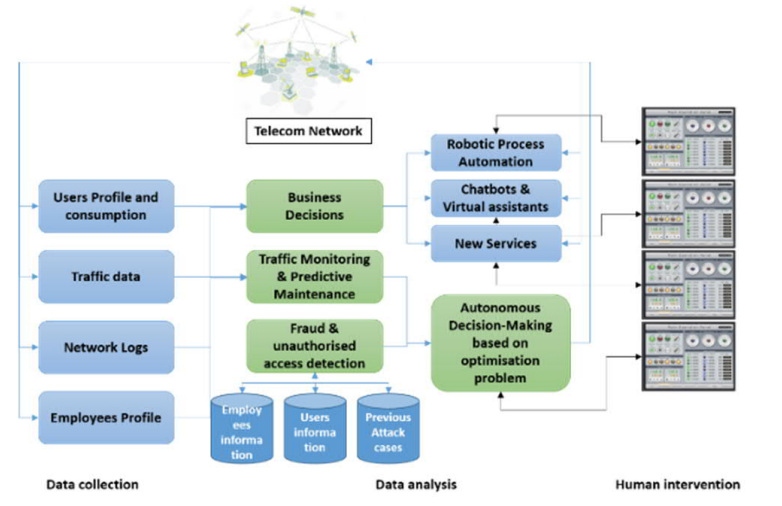
With the development of the 5G and Internet of things (IoT) applications, which lead to an enormous amount of data, the need for efficient data-driven algorithms has become crucial. Security concerns are therefore expected to be raised using state-of-the-art information technology (IT) as data may be vulnerable to remote attacks. As a result, this paper provides a high-level overview of machine-learning use-cases for data-driven, maintaining security, or easing telecommunications operating processes. It emphasizes the importance of analyzing the role of machine learning in the
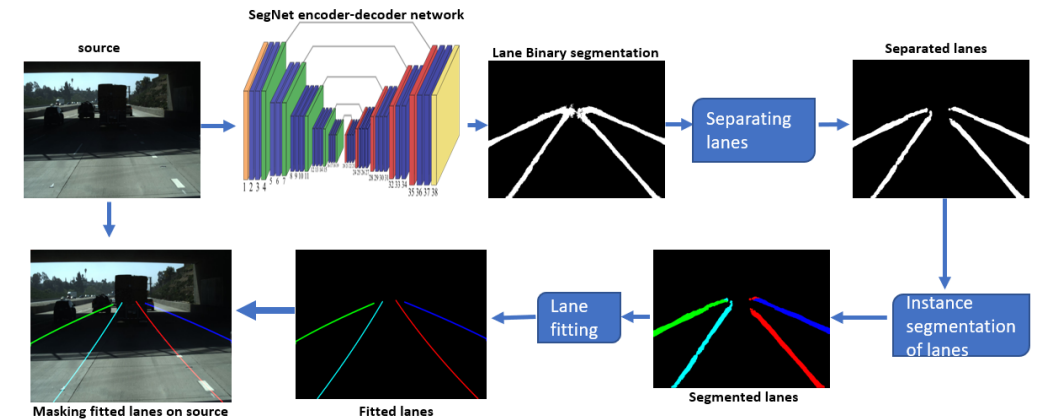
Real-Time Lane Instance Segmentation Using SegNet and Image Processing
The rising interest in assistive and autonomous driving systems throughout the past decade has led to an active research community in perception and scene interpretation problems like lane detection. Traditional lane detection methods rely on specialized, hand-tailored features which is slow and prone to scalability. Recent methods that rely on deep learning and trained on pixel-wise lane segmentation have achieved better results and are able to generalize to a broad range of road and weather conditions. However, practical algorithms must be computationally inexpensive due to limited resources